The first GLORIA Master Site dates back to 1994, when an extensive setting of permanent plots, arranged in transects across the alpine-nival ecotone was established at Mount Schrankogel in the central high Alps of Tyrol. These permanent plots were setup in response to evidences on upward shifts of alpine plants on high peaks of the Alps, reinvestigated in 1992 and 1993 (GOTTFRIED et al. 1994; GRABHERR et al. 1994, 2001; PAULI et al. 2001).
The 3497m-peak Mount Schrankogel belongs to the highest mountains of the Austrian Alps. Its northern and eastern side is surrounded by glaciers and glacier forelands. Its southern to western faces, however, are not interrupted by glaciers, but, show an altitudinal vegetation sequence characteristic for the central siliceous high Alps: from the lower-alpine zone, dominated by dwarf shrubs, to upper alpine Carex curvula-grassland, and finally to open and scattered nival vegetation on screes and solid rock.
Around 1000 permanent plots,
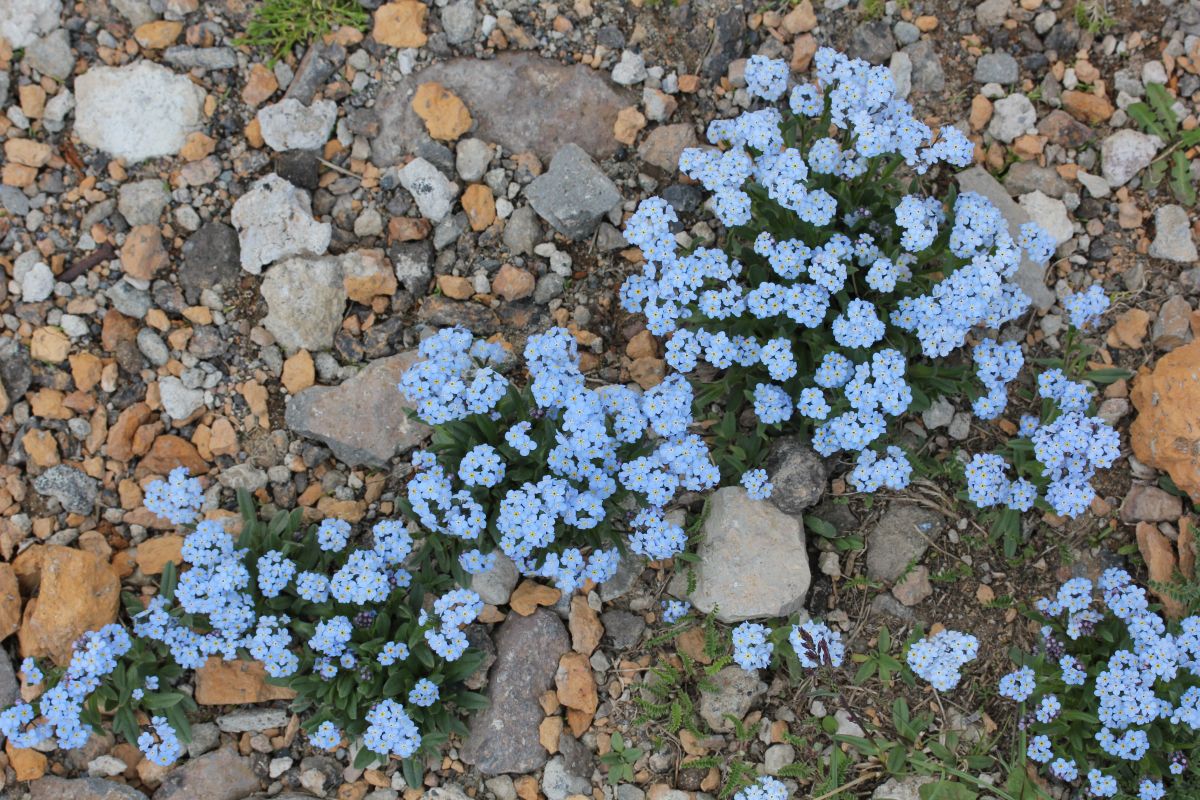
established in 1994, are distributed between 2900m and 3450m near the summit area, spanning across the alpine-nival ecotone from the upper margin of closed alpine grassland to the nival zone. Alpine grassland, dominated by Carex curvula and Oreochloa disticha, disintegrates within this ecotone to open scree and rock-dominated plant assemblages composed of subnival and nival cushion plants (e.g., Androsace alpina, Saxifraga bryoides), small rosettes (e.g., Ranunculus glacialis) and graminoids (e.g., Poa laxa, Luzula spicata).
Permanent plots of 1x1m
were arranged in transects on
the mountain's
south-western slope, at its
southern, south-eastern, and
eastern ridges.
Positions of the corner points of each quadrat were accurately surveyed by using a tachymetre and photographs were made from each plot. Percentage cover
of all vascular plant species and total percentage cover of bryophytes and lichens as well as the cover of abiotic surface components were recorded. Further,
a Digital Elevation Model of 1x1m-resolution, covering the entire study area, was generated.
Between 1994 and 2006, a number of additional studies were added to the extensive basic dataset of Schrankogel: Besides an area-wide vegetation mapping (ABRATE 1998; DULLINGER 1998) and a description of subnival to nival plant assemblages (PAULI et al. 1999), model studies on vegetation distribution and patterns in relation to the macro- and micro-relief and micro-climate were conducted (GOTTFRIED et al. 1998; GOTTFRIED et al. 1999, 2002). Based on these studies, scenarios of future distribution patterns of keystone species were developed. Scenarios for the currently common nival species Androsace alpina, for example, suggested a drastic area losses due to climate warming.
Further, the influence of domestic and wild-living ungulates (ERTL et al. 2002; HUELBER et al. 2005), nitrogen gradients (HUBER et al. submitted), permafrost patterns (HAEBERLI et al., unpubl.), flowering phenology and photoperiodism of alpine and nival vascular plants (KELLER & KÖRNER 2003; HUELBER et al. 2006), as well as patterns of bryophytes (HOHENWALLNER et al. 2002) were investigated. One of the most important additional dataset for the analysis vegetation development at the Schrankogel Master Site are temperature time-series, measured at around 40 positions distributed over the mountain's southern slope system since 1997.
What were the most obvious changes at Schrankogel's alpine-nival ecotone between 1994 and 2004? A re-investigation
of a representative one third of the Schrankogel permanent plots showed the following (PAULI et al. 2006):

The observed changes on Mount Schrankogel confirmed data-based model scenarios on climate-induced impacts on high-mountain plants (GOTTFRIED et al. 1998; GOTTFRIED et al. 1999, 2002) and showed - for the first time in the European Alps - signals of declines of the most cold-adapted species.
Pauli H., Gottfried M., Reiter K., Klettner C., Grabherr G. (2007) Signals of range expansions and contractions of vascular plants in the high Alps: observations (1994-2004) at the GLORIA* master site Schrankogel, Tyrol, Austria Global Change Biology (2007) 13, 147-156, doi: 10.1111/j.1365-2486.2006.01282.x
Hall, C. (2006) Mono County - performing high-altitude research on global warming. In: San Francisco Chronicle, San Francisco, Aug. 2 2006, pp B1, B5.
Walther, G.-R.; Beißner, S. & Burga, C.A. (2005) Trends in upward shift of alpine plants. Journal of Vegetation Science 16:541-548.
Bahn, M. & Körner, C. (2003) Recent increases in summit flora caused by warming in the Alps. In: Nagy, L.; Grabherr, G.; Körner, C. & Thompson, D.B.A. (Hg.) Alpine Biodiversity in Europe - A Europe-wide assessment of biological richness and change. Ecological studies 167, Springer, Berlin, pp 437-441.
Keller, F. & Körner, C. (2003) The role of photoperiodism in alpine plant development. Arctic Antarctic and Alpine Research 35:361-368.
Hohenwallner, D.; Zechmeister, H. & Grabherr, G. (2002) Bryophyten und ihre Eignung als Indikatoren für den Klimawandel im Hochgebirge - erste Ergebnisse. In: Bericht über das 10. Österreichische Botanikerteffen. BAL-Gumpenstein, Irdning, pp 19-21.
Abrate, S. (1998) Vegetationskarte des Schrankogel, Stubaier Alpen. In. Universität Wien, p 105.
Dullinger, S. (1998) Vegetation des Schrankogel, Stubaier Alpen. In: Diplomarbeit Universität Wien. Universität Wien, p 189.